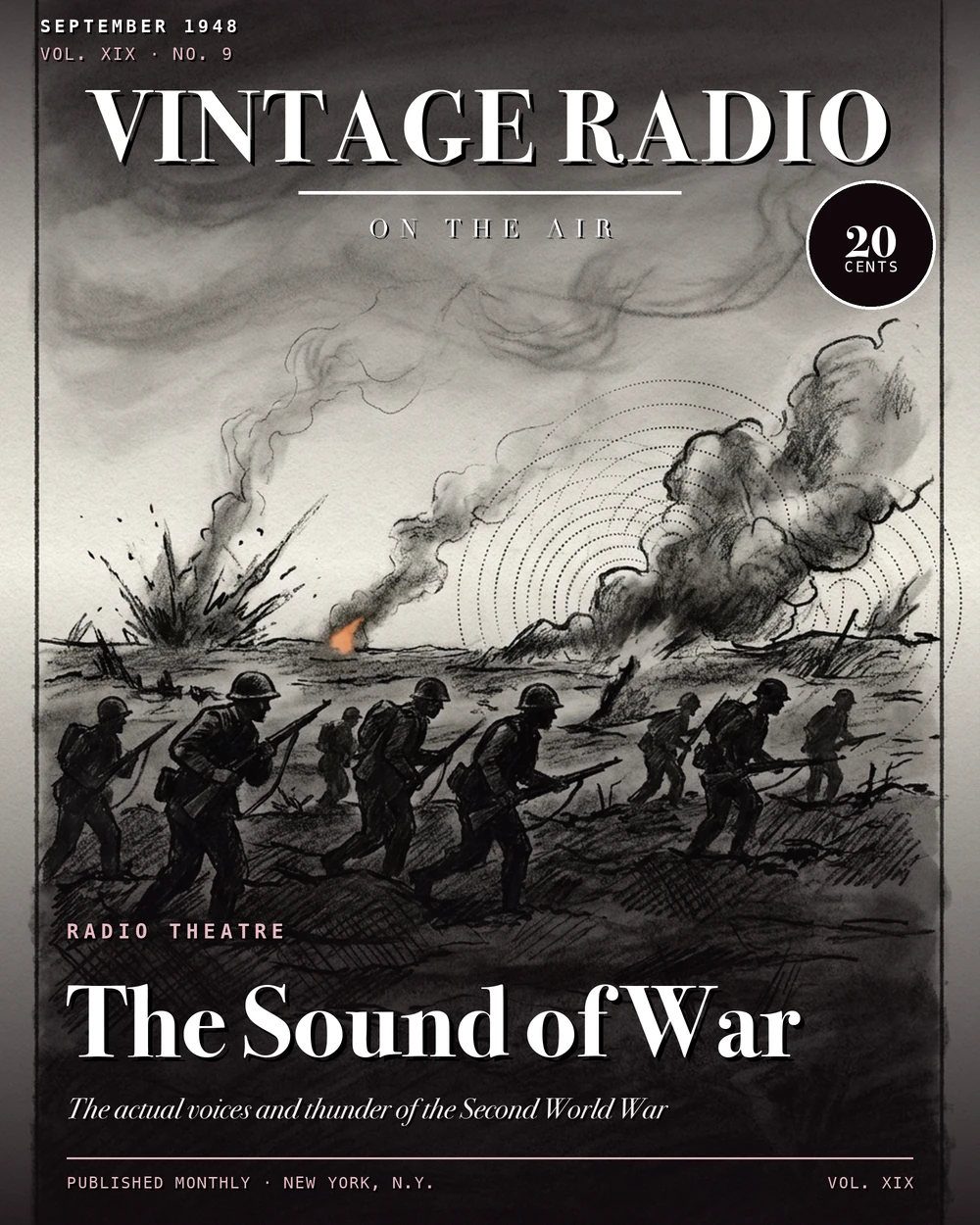
The Sound of War
What It Was
Produced around twenty years after the Japanese surrender, The Sound of War was an 18-part Westinghouse Broadcasting syndicated documentary that did something different from most radio treatments of World War II: it built its episodes out of the war's own sounds. Real speeches, real broadcasts, real battlefield recordings — the actual voices of the people who shaped the conflict, woven together with narration and orchestral music to create something closer to an immersive drama than a conventional history lesson.
The series carried a tagline that spelled out its ambition plainly: "The Actual Sound Record of World War II. A drama preserved for all time through the medium of radio. An era not to be forgotten." That wasn't idle copy. The show's scope was defined with unusual precision — 2,191 days, from the moment Hitler's Panzer divisions crossed the Polish border to the ceremony of Japan's surrender aboard the USS Missouri in Tokyo Bay. Every episode operated within that frame.
The series was produced, directed, and written by Bud Greenspan, with narration handled by his brother, credited on-air as David Perry. The combination of meticulous archival sourcing and a strong production hand gave the series a coherence that distinguished it from looser compilation formats. Both men would go on to prominent careers in documentary work — Bud Greenspan as the producer and director of ten official Olympic films, and David Perry as what he became known as: "the Voice of the Olympics," narrating multiple Olympic documentaries including 16 Days of Glory.
The Voices in the Archive
The archival recordings at the heart of the series weren't generic newsreel filler. The show featured the actual voices of Adolf Hitler, Franklin D. Roosevelt, Winston Churchill, Benito Mussolini, Neville Chamberlain, General Douglas MacArthur, Charles de Gaulle, Hermann Goering, and others. Where original speeches weren't in English, the series provided simultaneous translation rather than leaving listeners without context.
That roster of voices gave the program a texture that no actor could fully replicate. Hearing Chamberlain announce "peace for our time" after Munich, or Roosevelt addressing Congress after Pearl Harbor, carries a weight that a scripted dramatization simply doesn't. The production team understood that the recordings were the argument — their job was to link them intelligently, not to overshadow them. Narration and orchestral scoring served as connective tissue, keeping the chronology clear and the emotional stakes present without crowding the historical material.
The series did not just string together clips. The recordings and stories were shaped into a structured narrative, giving each episode a dramatic arc of its own while contributing to the larger 18-episode sweep of the war.
How the Series Was Structured
The 18 episodes followed a mostly chronological path through the war, with a few notable departures at the end. Early episodes covered Munich, the outbreak of the war, and the so-called Phoney War period. Middle episodes moved into the fall of France and the Pacific theater — Pearl Harbor, the Philippines, the Battle of Britain. Later episodes carried the story through D-Day and V-E Day.
The fall of France received particular editorial emphasis: the series devoted three full episodes to it, all titled "The Fall of France" with part numbers, a decision that reflects how significant that collapse was to the arc of the entire conflict.
The final three episodes stepped away from strict chronology. One examined wartime music. Another gathered what the title called "The Most Dramatic Voices and Sounds of the War" — a retrospective sweep through the audio record. The 18th episode covered V-J Day and the end of the war, bringing the series to a close at the same moment it had defined as its endpoint from the beginning.
Some individual episode titles give a sense of the series' range: "D-Day The Beginning of The End," "The Day They Attacked Pearl," "Climb Mount Niitaka," "Munich Victory Without Bloodshed," and "The Philippine Islands: Their Death… Their Life" — the last of which covered MacArthur's campaign in the Pacific, including the Bataan Death March.
The Complete Record
Jay Hickerson's reference work The Ultimate Guide to all Circulating Shows confirms that 18 episodes were produced for the series, and the series was certified as complete on January 31, 2011. The total running time of all 18 episodes comes to approximately 7 hours and 48 minutes — a substantial body of documentary audio for a single series.
The precise broadcast date involves some uncertainty. Metadata in the surviving recordings suggested the episodes appeared to originate from the late 1950s or early 1960s, while other sources identify the series as a 1965 Westinghouse Broadcasting production. The weight of sourcing points to 1965, which would place the broadcast roughly two decades after V-J Day — a natural moment for a retrospective series of this kind, when the war was recent enough to carry emotional immediacy but distant enough to assess in full.
Why It Holds Up
A show built around real recordings faces a test that scripted drama doesn't: the material either speaks for itself or it doesn't. The Sound of War worked because Bud Greenspan understood that the archive wasn't the endpoint — it was the raw material. Structuring 18 episodes out of footage that could easily have become a shapeless montage required real editorial judgment about what to include, what to cut, and how to frame what remained.
The program was also honest about what it was trying to do. Its own tagline described it as drama preserved through radio, not just documentation. That framing matters: it acknowledged that selecting, sequencing, and scoring archival material is itself a creative act, and it committed to doing that act well rather than hiding behind the authority of the recordings alone.
Related programs in the same tradition — Men Who Made America, Adventures in Research, and Pacific Story — worked similar territory, but few assembled a wartime archive at this scope or with this level of production coherence. The 18-episode run and its certified completeness make it one of the more intact documentary series from the format.